Individual product picks
Useful for variable products, lower rates or controlled placement onto a conveyor. Each product position and grip must be reliable.

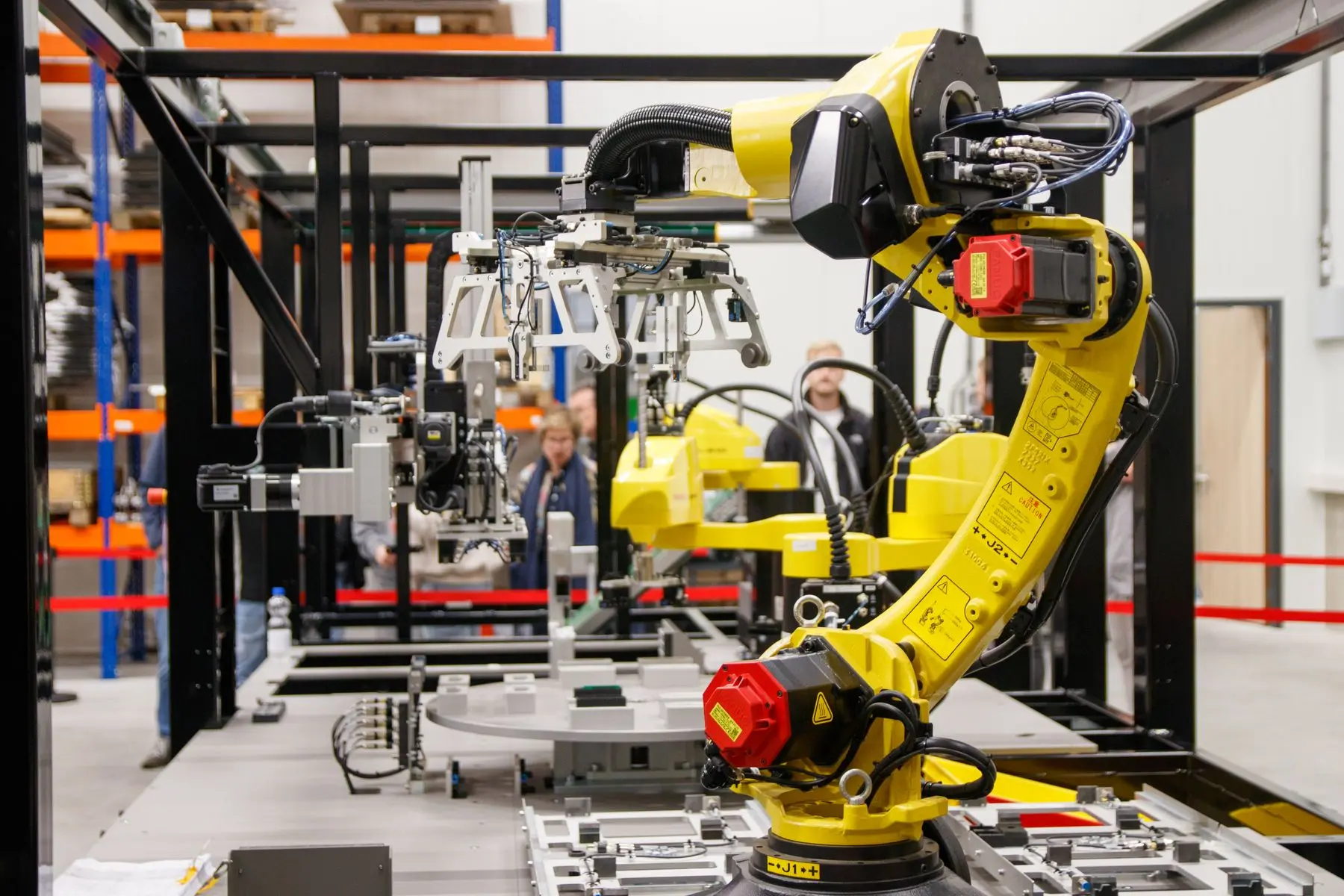
Automated pallet unloading
Unload boxes, bags, trays, bottles or containers by individual product, row or layer—with tooling, sensing, pallet handling and controls designed around real incoming-load variation.
Quick answer
The cell architecture depends on whether loads are consistent or mixed, the condition of boxes or bags, required discharge rate, layer-sheet use, pallet quality and the permitted operator interaction. Vision is used where it solves measured variation—not automatically.
Application routes
Useful for variable products, lower rates or controlled placement onto a conveyor. Each product position and grip must be reliable.
Groups several compatible products to increase throughput while keeping the total payload and release sequence controlled.
Moves a full layer where product stability, tooling capacity and downstream separation allow it.
Incoming-load assessment
Mixed or variable pallets
Tell us what can change: product identity, position, height, orientation, layer pattern or pallet condition. That evidence lets us assess whether fixed sensing, 2D vision, 3D vision or a controlled mechanical presentation is appropriate.
Send an incoming-pallet videoComplete cell scope
Conveyors, pallet location, centring and safe transfer into the robot work zone.
End effector, pick confirmation and vision where incoming variation requires it.
Controlled release, orientation, spacing and accumulation for the downstream process.
Layer sheets, empty pallets, damaged products and operator recovery managed in the sequence.
Related palletising guidance
Frequently asked questions
Robotic depalletising removes products from a loaded pallet and places them onto a conveyor, process machine or other controlled destination. The system can pick individual packs, rows or complete layers depending on the product and required rate.
Not always. Repeatable pallets may use taught positions and sensors, while variable stack position, mixed loads, damaged layers or unknown product orientation may require 2D or 3D vision. The variation should be measured before the sensing method is selected.
Potentially, if the work envelope, tooling, cycle demand and controls sequence are compatible. A combined function must be assessed against production conflicts and the required availability of each process.
A tool can remove and place interlayer sheets into a magazine or waste station. Sheet porosity, curl, static, adhesion and the possibility of double picks need to be considered and detected.
Empty pallets can be removed manually or transferred by conveyors, stackers, dispensers, shuttle systems or forklift interfaces. The route is designed around site access and the required level of automation.
Start with the application
Send the packaged-product dimensions and mass, current line rate, required pallet pattern, available space and a photo or video of the end of the line. We will identify the next technical step.
Planning a palletising project?
Send the product dimensions and weight, target output, pallet size and a photo or short video. We will review the application and identify the next technical step.