Container stability
Base geometry, height-to-width ratio, fill level and closure determine how the pack can accelerate and settle.

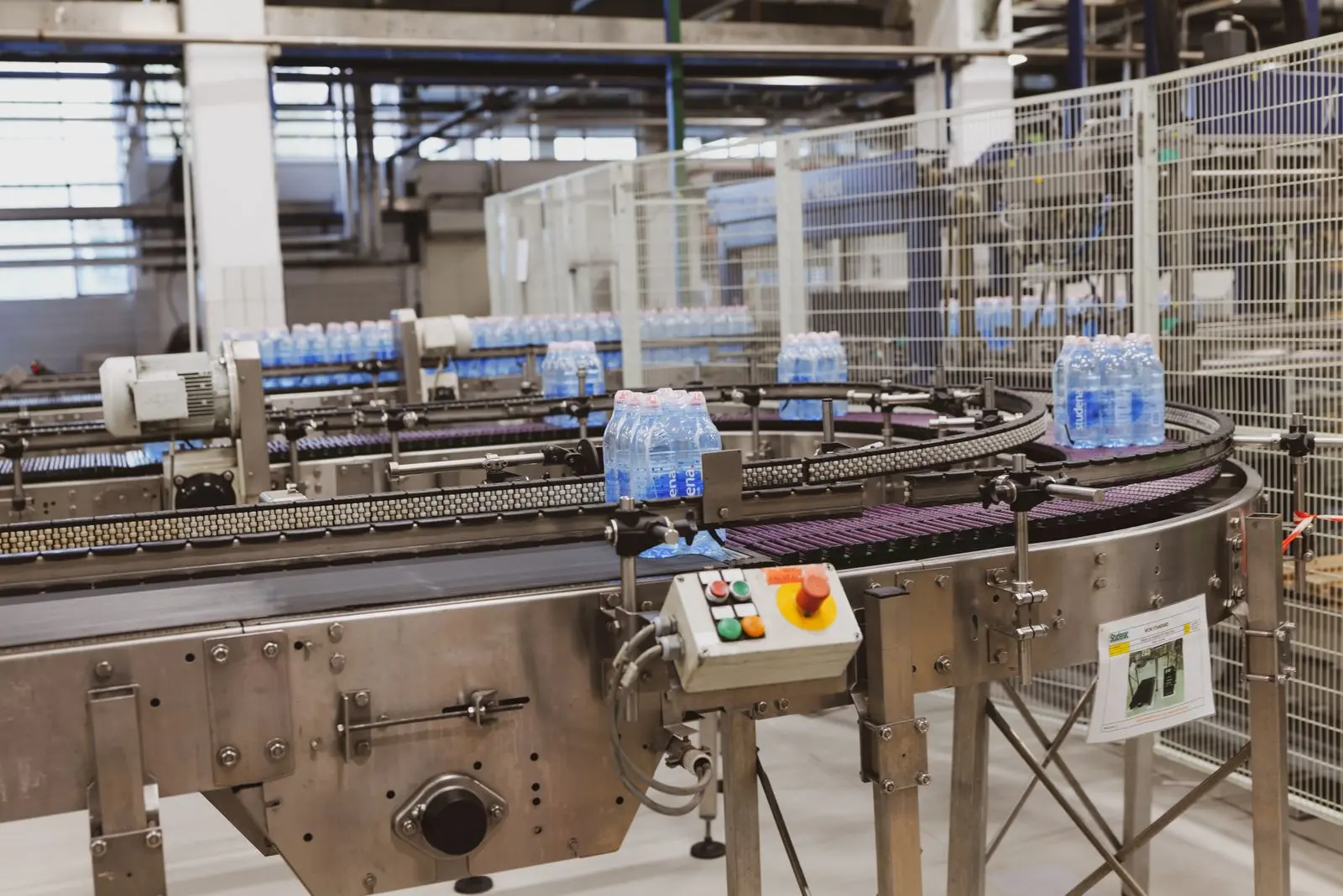
Bottle and container palletising
Automate the end of your bottling or packing line with controlled handling for bottles, cans, jars, trays, shrink packs and other stable container formats.
Application engineering
A sealed case of bottles behaves very differently from a shrink-wrapped tray or an unsupported group of containers. We establish whether the robot will pick individual packs, rows, collations or a complete layer before selecting tooling.
Container stability, cap geometry, glass or plastic construction, label protection and line accumulation all influence the cell architecture.
Base geometry, height-to-width ratio, fill level and closure determine how the pack can accelerate and settle.
Single packs, rows, trays, shrink collations or full layers require different lane formation and support.
Labels, sleeves, printed film, glass and closures may create controlled contact or no-contact areas.
Trays, layer pads, top frames and pallet condition can be central to the stability of the finished load.

Complete cell design
The most effective pick strategy depends on rate, product stability and the level of upstream collation. Vacuum, clamp and support tooling can be combined with lane-forming conveyors or layer tables where appropriate.
The cell can coordinate pattern recipes, layer pads and pallet exchange so the container flow is not treated as a standalone robot movement.
What we need to know
Bottle palletising can refer to direct container handling or to cases and shrink packs. Identifying the real pick unit at the outset prevents the wrong architecture being selected.
| Design input | Why it matters | What to provide |
|---|---|---|
| Pick unit | Determines whether the cell needs collation, layer forming or conventional case handling. | Individual bottle, row, tray, shrink pack, carton or complete layer. |
| Container details | Material, mass, centre of gravity and contact limits affect support and acceleration. | Dimensions, filled weight, material, closure and representative samples. |
| Line presentation | Lane count, pitch and accumulation define how a repeatable group reaches the robot. | Conveyor width, speed, lane layout and upstream controls information. |
| Output | The number of containers per pick can be as important as robot cycle time. | Containers/min, packs/min, collation size and production schedule. |
| Pallet build | Layer pads, trays, interlock and overhang rules influence load stability. | Pallet and pattern drawings, maximum height and downstream movement. |
Integrated around the robot
The system creates a stable, repeatable pick from a continuous product stream and manages each layer without damaging the saleable pack.
Guide rails, metering, diverts, stops, grouping and product detection establish the required row, collation or layer.
Tooling is designed around allowable contact, label protection, closure geometry and the support needed through the robot path.
Pattern recipes, pads or trays, pallet presentation and full-load outfeed are coordinated within the cell controls.
Project route
A palletising project is only complete when the robot, product flow, pallet handling, control system and operator access work together. We keep the system boundary clear from the first layout.
See complete cell integrationProducts, rates, patterns, pallet formats, line interfaces and site constraints.
Robot, end effector, conveyors, safety architecture, controls and cell layout.
Programming, dry testing, product trials, recipe checks and agreed acceptance evidence.
Installation, commissioning, operator training and production handover.
Frequently asked questions
Potentially. Direct bottle handling normally requires controlled lane or layer formation and suitable support. Container stability, material, cap geometry, fill level, rate and layer interface must be assessed.
It may be possible where the size range, grip surfaces and pattern requirements overlap. Tooling can use controlled zones or change parts, but suitability is confirmed against samples and cycle targets.
We define acceptable contact areas, control gripping force and support the pack through the motion path. The actual label, sleeve or printed-film position is included in the tooling review.
Yes. Layer-pad magazines and pick tooling can be integrated where pads are required for stability or product separation.
The control scope can include run, stop, blocked, ready, fault and product-change signals with upstream and downstream equipment. Exact interfaces are agreed during design.
Related systems
Start with the application
Send the packaged-product dimensions and mass, current line rate, required pallet pattern, available space and a photo or video of the end of the line. We will identify the next technical step.
Planning a palletising project?
Send the product dimensions and weight, target output, pallet size and a photo or short video. We will review the application and identify the next technical step.


