Shared robot, fixed pallet bays
Multiple infeeds and pallet positions within one work envelope. Useful where product and pallet routes are compact and coordinated.

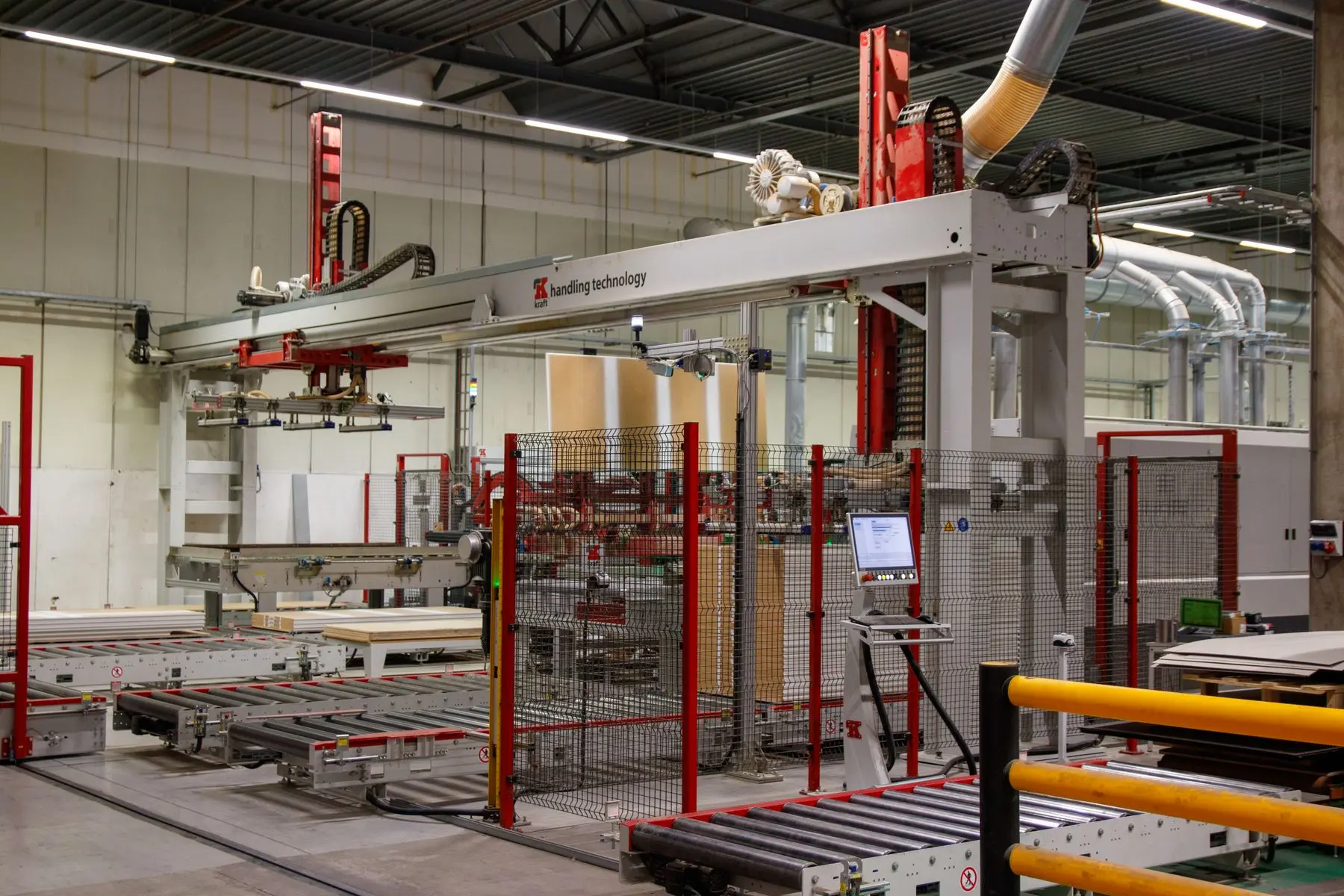
Central end-of-line automation
Combine demand from two or more packaging lines where cycle-time, buffering, reach and production resilience support it. We model line priority, product routing, pallet destinations and operator access before defining the cell.
Quick answer
A useful study maps each line’s products per minute, peak behaviour, pallet patterns and changeovers. It then tests robot motion, buffer capacity, line-priority rules, pallet exchange and recovery from simultaneous demand or equipment stops.
Architecture choices
Multiple infeeds and pallet positions within one work envelope. Useful where product and pallet routes are compact and coordinated.
Product conveyors route several lines to one or more robots, with automatic pallet, sheet and full-load handling.
Separate palletisers can simplify interfaces and protect line availability. They should remain part of the commercial comparison.
Engineering inputs
| Design question | Why it matters | Evidence to provide |
|---|---|---|
| Combined demand | Simultaneous peaks can exceed a robot that appears adequate on average. | Rate by line and SKU, peak duration, shifts and expected line availability. |
| Buffering | Accumulation decouples short events but can consume space and complicate product tracking. | Permitted accumulation time, pack stability and stop/start constraints. |
| SKU destination | Each product must reach the correct pallet, pattern and customer order. | SKU list, identification method, pallet rules and changeover frequency. |
| Pallet exchange | Waiting for a forklift or empty pallet can stop more than one production line. | Manual or automatic workflow, pallet types and full-load collection route. |
| Fault strategy | A shared asset can affect several lines unless recovery and bypass routes are planned. | Required resilience, maintenance access and acceptable fallback process. |
Integrated line control
Defined priorities choose the next valid pick without starving another production line.
Product, tool, pallet and pattern parameters change as one validated production recipe.
Build state, destination, sheet requirements and full-pallet status remain visible.
Pallet exchange and intervention zones are designed so permitted work is clear and controlled.
Related palletising guidance
Explore conveyors, pallet handling, PLC/HMI and safety scope.
Read this guideControl multi-SKU recipes and validated changeovers.
Read this guideCompare central and independent cells on a complete installed scope.
Read this guideFrequently asked questions
Yes, when the combined cycle demand, travel distance, buffering and pallet-change sequence fit the required output and availability. A time study should include peaks, simultaneous demand and fault recovery—not just average rate.
A dual-pallet layout provides two pallet positions. It may allow one pallet to be exchanged while the robot builds another, separate SKUs or patterns, or route products to different destinations. The safety and access sequence must be engineered around the chosen workflow.
Product identification, line source, barcode data or recipe selection can be used to direct compatible products to the correct pallet. The PLC tracks product and pallet status and prevents an invalid placement.
The control strategy can continue serving other available lines where the layout and recipes allow it. Buffer limits, priority rules and recovery behaviour are agreed during the functional design.
It depends. A central cell may reduce duplicated equipment and automate pallet flow, while separate cells can provide simpler interfaces and production independence. The comparison should consider rate, space, resilience, future expansion and maintenance access.
Start with the application
Send the packaged-product dimensions and mass, current line rate, required pallet pattern, available space and a photo or video of the end of the line. We will identify the next technical step.
Planning a palletising project?
Send the product dimensions and weight, target output, pallet size and a photo or short video. We will review the application and identify the next technical step.