Total moving mass
Product or multi-pick group, tooling, brackets, valves and services are combined in the payload calculation.

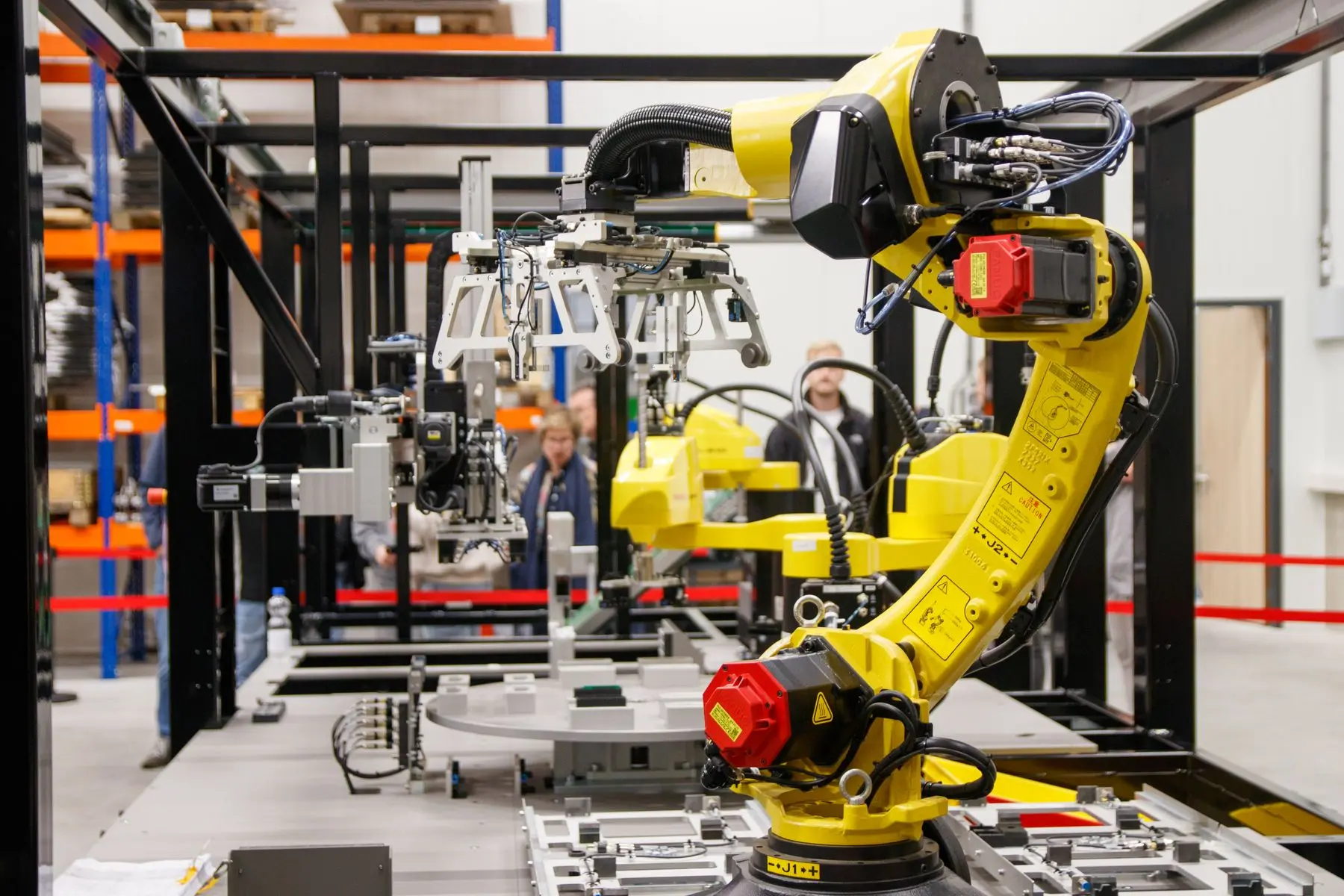
High-payload robotic palletising
Automate heavy bags, large boxes, bottle packs and multi-pick loads with a long-reach cell engineered for the complete moving payload and your production duty.
Application engineering
A high payload figure does not prove a robot can palletise a particular product. The end effector, load offset, acceleration, wrist moments, approach path and required duty must all remain within the selected platform’s limits.
We model the complete moving assembly and proposed cell geometry, then coordinate product and pallet handling around the robot.
Product or multi-pick group, tooling, brackets, valves and services are combined in the payload calculation.
Large or eccentric loads can create limiting moments even when their mass is below the headline payload.
Pick position, two or more pallets, top layer, slip sheets and clear approach angles define usable reach.
Robot base, pallet stops, guarding and high dynamic loads require a suitable mechanical installation.

Complete cell design
Oxford Industrial Automation lists an 80 kg four-axis palletising reference platform with 2,400 mm reach and a 160 kg multifunctional palletising reference platform with 3,100 mm reach. These are starting points for application assessment, not a complete cell specification.
Final selection is confirmed only after the product, end effector, paths, cycle, environment, safeguarding and surrounding equipment have been reviewed.
What we need to know
The heaviest product is not always the limiting case. A lighter, larger or more eccentric pack can create a more demanding moment at the robot wrist.
| Design input | Why it matters | What to provide |
|---|---|---|
| Load cases | Different SKUs and multi-pick groups create different mass, centre-of-gravity and inertia conditions. | Dimensions, mass, centre of mass if known and pick quantity for every SKU. |
| Tool concept | Tool weight and load offset can consume substantial robot capacity. | Preferred contact areas, prohibited surfaces and required functions. |
| Work envelope | Long reach at the highest layer or far pallet may be the limiting position. | Dimensioned layout, pallet positions, heights and access constraints. |
| Cycle and duty | Acceleration, dwell, multi-line demand and shift pattern affect performance and thermal duty. | Products/min, pick grouping, shifts and expected availability. |
| Installation | Base loads, floor quality and traffic separation affect mechanical and safety design. | Floor information, site photos, services and forklift routes. |
Integrated around the robot
The robot, end effector, base, conveyors, pallet fixtures and safeguarding are treated as one machine with defined load cases and interfaces.
Structural frame, gripping method, compliance, sensors and service routing designed for the real product and worst-case motion.
Robot base, floor interfaces, guarding posts, pallet location and conveyor structure coordinated around dynamic loads and access.
Product demand, multi-line arbitration, pallet status, recovery and safe access managed through PLC, HMI and safety control.
Project route
A palletising project is only complete when the robot, product flow, pallet handling, control system and operator access work together. We keep the system boundary clear from the first layout.
See complete cell integrationProducts, rates, patterns, pallet formats, line interfaces and site constraints.
Robot, end effector, conveyors, safety architecture, controls and cell layout.
Programming, dry testing, product trials, recipe checks and agreed acceptance evidence.
Installation, commissioning, operator training and production handover.
Frequently asked questions
It may involve heavy individual products, several products per pick, a large or offset end effector, long reach, high stack height, multi-line demand or sustained duty. The full load case and work envelope define the requirement.
Not necessarily. The stated robot payload must also carry the end effector, brackets, hoses and other moving components, and allowable wrist moments and inertia must be respected. A 160 kg product would therefore normally need a higher-capacity platform.
Potentially. A multi-line layout requires a cycle-time and reach study, product-buffer strategy and rules for prioritising demand from each line.
Possibly, but the gripping requirements may be very different. A common tool, controlled change parts or automatic tool changing can be assessed against rate, payload and complexity.
The installation requirements form part of the cell engineering. Final base and floor suitability must be confirmed against the selected robot, dynamic loads and site conditions.
Related systems
Start with the application
Send the packaged-product dimensions and mass, current line rate, required pallet pattern, available space and a photo or video of the end of the line. We will identify the next technical step.
Planning a palletising project?
Send the product dimensions and weight, target output, pallet size and a photo or short video. We will review the application and identify the next technical step.